What our grounding products are made of
The full composition of every product: 95 percent organic cotton with silver thread in the bedding, vegan leather with TPE or rubber in the mats. Plus where the cotton comes from, down to the Indian state, and what has been independently tested.

You put a grounding sheet on your mattress and then sleep on it for years. So you are entitled to know what is in it. Not "high-quality materials", but the list.
It is below, product by product. After that comes where the cotton comes from and what has been tested.
What is in each product
| Product | Composition |
|---|---|
| Pillowcase | 95% organic cotton, 5% silver thread |
| Flat sheet | 95% organic cotton, 5% silver thread |
| Fitted sheet | 95% organic cotton, 5% silver thread |
| Duvet cover | 95% organic cotton, 5% silver thread |
| Blanket | 68.5% polyester, 29.5% organic cotton, 2% silver thread. Soft polyester top, cotton with silver thread on the underside. |
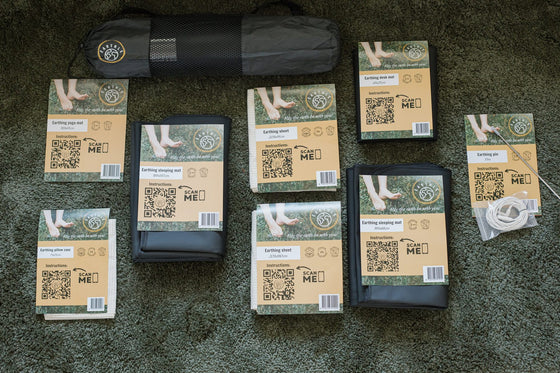
| Yoga mat (5 mm) | TPE with a conductive top layer of vegan leather |
| Desk mat (2 mm) | Rubber with a conductive top layer of vegan leather |
| Sleeping mat (0.8 mm) | Conductive vegan leather |
The textile: organic cotton with silver thread
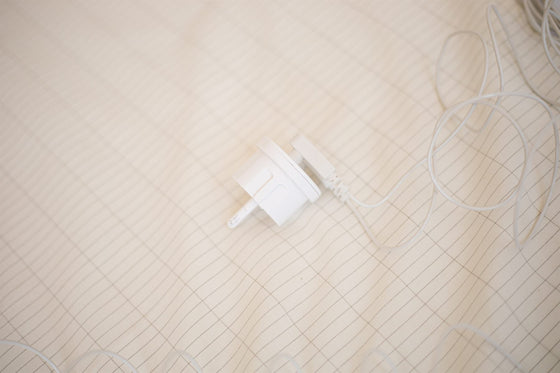
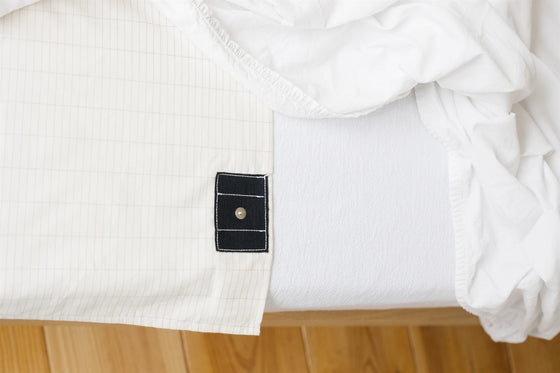
The pillowcase, flat sheet, fitted sheet and duvet cover are 95 percent organic cotton with 5 percent silver thread woven through. What touches your skin is therefore cotton. The silver sits inside as a grid rather than as a layer on top, and you can see that check pattern in the fabric.
That difference only shows over time. A conductive surface is cheaper to make by spraying a metal layer onto it, and that comes off once you have washed it a few times. Woven thread stays put, which is why our textile simply goes in the machine at 40 degrees.
The blanket is built differently, because it goes over you rather than under you. The top is soft polyester for warmth, the underside is the organic cotton with the silver thread, and that is the side you touch.
Where the cotton comes from
The cotton is organic cotton from India, from the states of Rajasthan, Gujarat, Madhya Pradesh and Maharashtra. It was grown, spun and woven into greige fabric there, and in February 2025 delivered in fourteen bales totalling 1,284.80 kilos to the mill that makes our sheets.
That is not in a brochure but on a transaction certificate, issued by Control Union Certifications in Zwolle. A certificate like that covers a single shipment and states the weight, the date and the origin of the raw material, verified by an independent body. The cotton also meets the American and Indian rules for organic farming, USDA NOP and APEDA NPOP.
The mill itself has additionally been assessed by Bureau Veritas against the Global Organic Textile Standard, the strictest norm that exists for organic textiles. That assessment covers the factory; the transaction certificate covers the shipment. Together they make the cotton's route traceable.
Why the certification covers the cotton
On that certificate the product description reads: woven greige fabric, 100 percent organic cotton. That is exactly the moment the cotton arrives at the mill, just before the silver thread goes in.
Certification cannot go further than that, and that is down to the standard itself: metal fibre cannot be certified under GOTS. So the strictest option available was chosen, namely certification of the cotton up to the mill.
That makes the cotton's route traceable all the way back to the fields where it grew, which is exactly what we wanted to know.
The mats: vegan leather
A mat lies on a floor or a desktop. It has to stay put, wipe clean and conduct at the surface. Cotton cannot do that, so there it is vegan leather, made conductive with carbon. No animal material, and the whole surface conducts without a thread in sight.
Under that top layer sits TPE in the yoga mat and rubber in the desk mat, for firmness and grip. The sleeping mat is leather only, 0.8 millimetres thin, so it fits under a fitted sheet without you feeling it. It is the same leather in all three mats; only the backing differs.
What has been tested
SGS measured the silver-cotton fabric in September 2025, report number SL22502333495502TX. From it:
- Formaldehyde: not detectable.
- Twenty-four aromatic amines from azo dyes: all below the detection limit.
- Twelve extractable heavy metals, measured in artificial perspiration: all below the detection limit. Among them nickel, lead, cadmium, mercury and chromium VI. Nickel is the most common contact allergy, and there is metal in this fabric; the fact that it does not come out in sweat is therefore no small thing.
- Acidity: pH 7.4, comfortably within the 4.0 to 7.5 norm and close to that of your skin.
- Odour: odourless.
- Colour fastness to dry rubbing, to perspiration, to water and to saliva: 4-5 throughout, on a scale of 5.
- Pilling: 4-5 up to a thousand revolutions.
An earlier report on the same fabric adds abrasion resistance: 11,000 rubs.
The leather in the mats was screened by SGS in May 2026 for 253 substances of very high concern from the REACH candidate list. Everything below 0.1 percent, the European limit.
The cable with plug was assessed in March 2025 against the reuse, recycling and recovery requirements of article 11 and annex V of the European WEEE Directive.
Why we write it this way
Plenty is claimed in this market with no paperwork behind it. We would rather put out the documents we do have.
For the same reason we explain in What to look for in a grounding product how to check for yourself, with a twenty-euro multimeter, whether our sheet does what we say. A number on a package can be copied. A measurement cannot.
If you have a question about the materials, the origin or washing, email us at info@earthle.nl. We answer personally. The most common questions are on the frequently asked questions page.