Sports Performance and Grounding: Why Athletes Use It
Earthing offers athletes numerous benefits, such as reduced inflammation, improved blood circulation, and faster recovery. By integrating earthing into their routine, athletes can perform better and reduce stress. Discover the power of earthing for optimal sports performance!

Training is not the moment you get stronger. That happens in the hours and days afterwards, while your body repairs the damage you did. Anything that speeds up that recovery therefore counts twice, and that is exactly the angle athletes look at grounding from.
The blood
Recovery is about flow: oxygen and nutrients into the muscle, waste products out. In 2013 Chevalier and colleagues measured an average 2.7 times higher charge on the red blood cells of ten participants after two hours of grounding. Cells with more charge repel each other more strongly and therefore clump together less, which helps circulation. Published in the Journal of Alternative and Complementary Medicine.
If you take blood thinners, discuss it with your doctor before you start, and never change your dose yourself.
Muscle soreness after training
The soreness that arrives a day or two after a hard session is an inflammatory response to micro-damage in the muscle. In 2010 Brown, Chevalier and Hill ran a pilot study on what grounding does to it, and saw a milder course of pain and muscle-damage markers in the grounded participants than in the control group.
That fits the broader line in the research on grounding and inflammation: free electrons from the earth help neutralise free radicals, so inflammatory processes run milder. All the studies, with year and number of participants, are in scientific evidence for grounding.
The night is your most important recovery block
This is where athletes have the most to gain, and not because grounding works differently at night. It is simply the only time you get eight uninterrupted hours of contact without having to do anything for it. Twenty minutes after training is good; eight hours is more.
On top of that, growth hormone and muscle repair do their work precisely during deep sleep. What has been measured on grounding and sleep is in better sleep through grounding.
How to fit it in
Barefoot on the grass after training is the free version, and after an outdoor session also the easiest. Damp grass works better than dry; the details are in walking barefoot outdoors.
Indoors, the yoga mat is the obvious one: you use it during your stretching and mobility work, so you do not have to set aside any extra time. If you spend much of the day sitting, the desk mat does the same under your forearms.
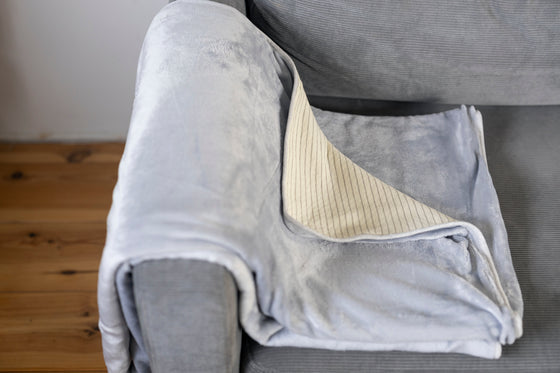
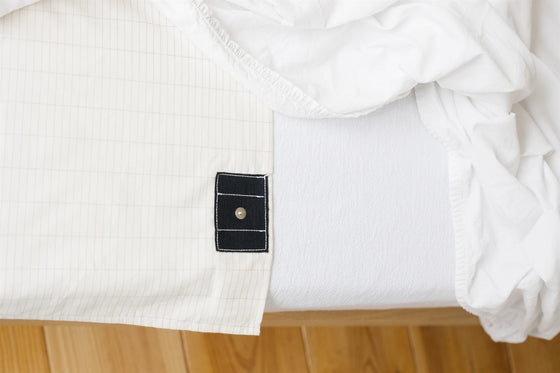
For the night the sheet is the usual choice, or the sleeping mat if you only want to ground part of the bed. If you want to start small, the pillowcase is the smallest step.
Travelling and training camps
In hotels and holiday lets you never know how the wiring runs, and in a camper van there is often no earth connection at all. An earthing rod solves that: you push it into the ground outside and bring the connection in over fifteen metres of cable, completely independent of the local installation. There is more on that in grounding without an earthed socket.
Measure instead of guessing
Athletes are used to data, so just measure it. With a multimeter set to AC volts you can watch the voltage on your skin drop from a few hundred millivolts to almost nothing as soon as the connection is made. And if you already wear a watch or ring that tracks your sleep, compare the two weeks before with the two weeks after. That tells you more than a feeling.
Which product and which size suit your situation is what the guide at the bottom of the shop page asks you in a few short steps. You have thirty days to change your mind, so you can try it for a training block and see for yourself what it does to your recovery.
Earthle does not sell medical devices and does not replace treatment. If you have an injury or health complaints, take medication or have an implant, talk to your doctor or physiotherapist first.